Advertorial
A wholesaler wanted to buy these knives for $65 to resell them for $450. The blacksmith preferred to sell them directly to home cooks for $99
After 50 years forging exceptional knives in American's most celebrated bladesmithing region, Jack Morrison no longer has the strength to hold the hammer. We investigated a story that has moved an entire region.
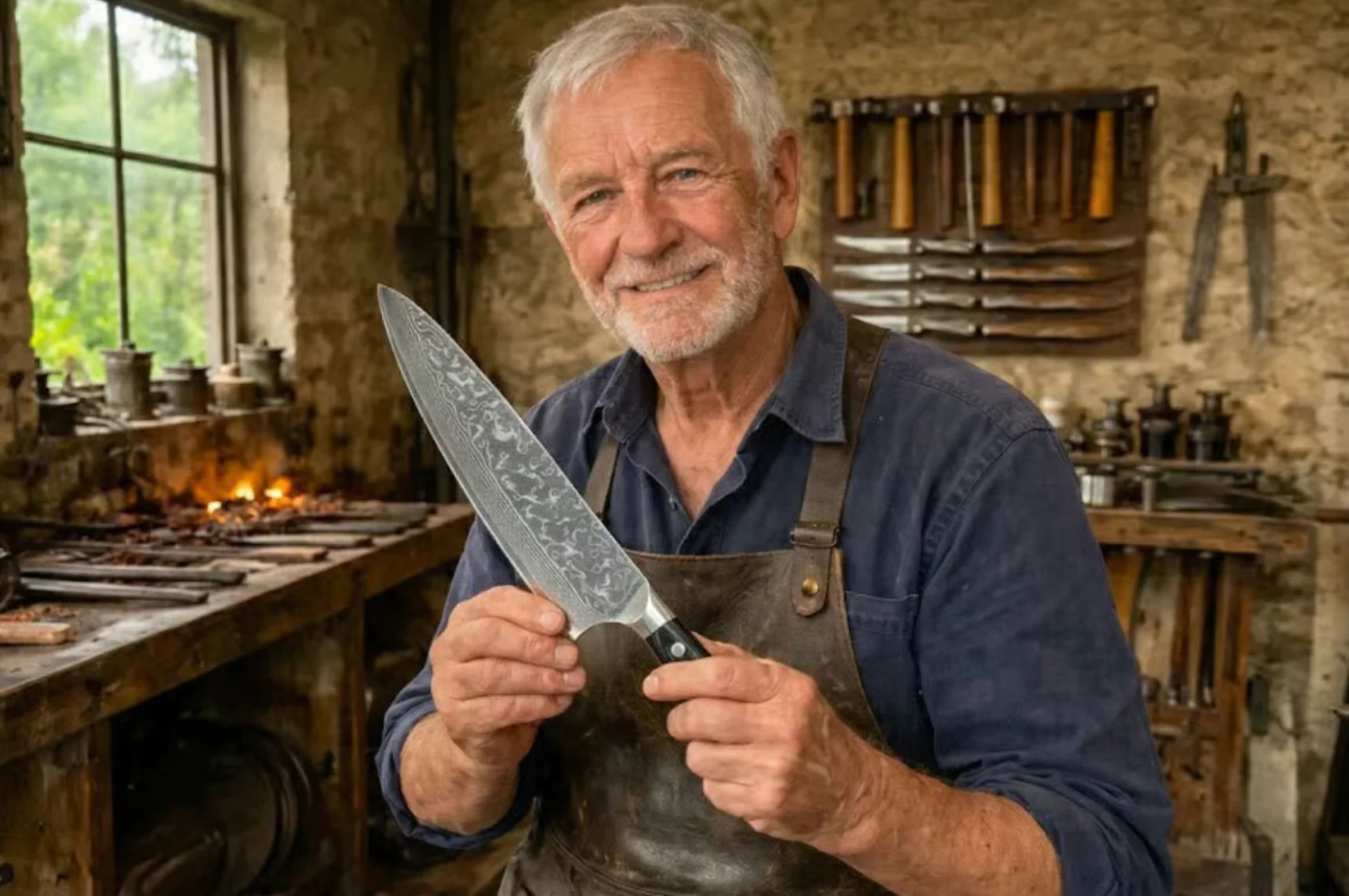
Lititz, Pennsylvania — Jack Morrison, 76, will light his forge fire for the last time on 30 March 2026. In his 35m² workshop tucked into a cobblestoned laneway in the old town, he is stacking his creations for the final time: knives forged one by one in Damascus steel, with noble wood handles and polishes.
The reason for the closure? Arthritis that has been destroying his hands for three years, a body that refuses to keep pace, and above all the void left by Margaret, his wife, who passed away five years ago. "She was the one who kept the business going," he murmurs, staring at the anvil. "Without her, all I know how to do is forge. And even that, soon, I won't be able to do anymore."
Before closing for good, the master bladesmith has made a decision that has surprised everyone: sell his limited remaining blades at $99 instead of $349. A clearance that has nothing to do with a marketing exercise. It is the final wish of a man who wants his knives to "end up in kitchens, not in a skip."
Our investigation reveals how half a century of passion is about to be extinguished, and why this closure resonates far beyond the village of Healesville.
Forging in the blood: when a son picks up his father's hammer
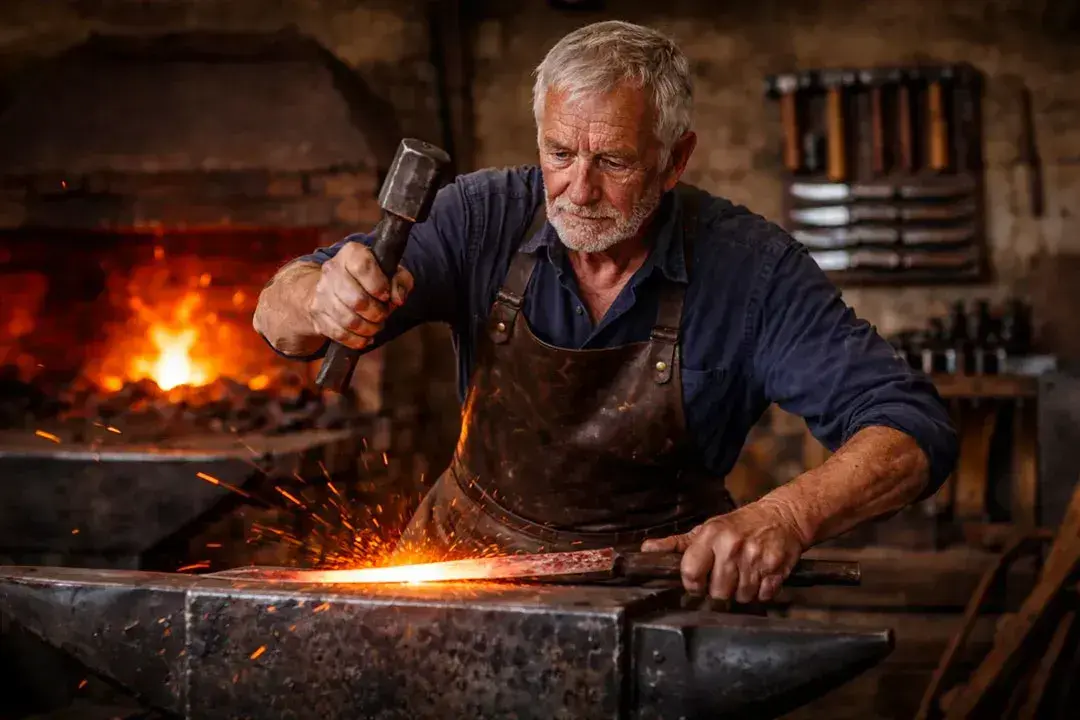
Jack Morrison did not choose bladesmithing. Bladesmithing chose him.
His father, Robert Morrison, was himself a blacksmith in Healesville — that quiet Victorian town nestled in the Yarra Valley hills where Jack built his forge forty years ago. At six, Jack spent his Wednesdays watching his father transform steel bars into blades. At twelve, he was holding his first hammer. At twenty-six, he opened his own forge in the workshop Robert handed down when he retired.
"My father taught me one thing," says Jack, hands resting on his worn leather apron. "A knife is not a tool. It is an extension of the hand of the person who uses it. If the blade isn't perfect, you've let the cook down."
That philosophy he applied for fifty years. Not a single blade left his forge without being checked, sharpened, and tested by his own hands. Starred chefs from the region, butchers, restaurateurs — everyone knows Jack Morrison's blades. Some have been using the same knife for thirty years.
"The knife Jack forged for me in 1997 still cuts like the day I got it. I offered it to my son when he took over the restaurant. He refused. He said: go get one forged yourself — this one I'm never giving back."
— David Hartley, restaurateur, Melbourne
But in 2021, everything changed.
Margaret passes away: when the forge becomes the last refuge
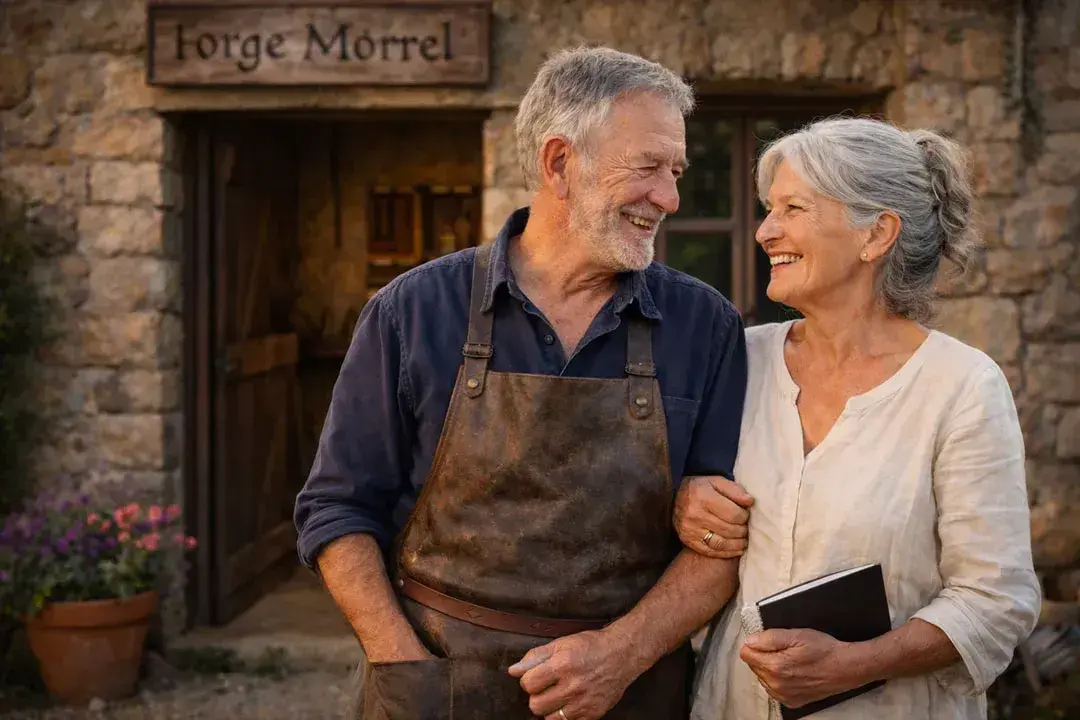
February 2021. Margaret Morrison passes away after eighteen months fighting pancreatic cancer. Forty-seven years of marriage. Forty-seven years managing the accounts, running the market stalls, packing orders, answering the phone while Jack forged.
"Margaret was my other half in every sense," he says, his voice breaking. "She knew how to sell what I knew how to create. Without her, I'm a mute blacksmith."
In the first months after her passing, Jack stops setting foot in the forge. The house is empty. The days are endless. His son Eric, who lives in Melbourne, is worried. He offers to come and help, to take over the business. Jack refuses.
One April morning, unable to sleep, he goes down to the workshop at 5am. He lights the fire. Places a steel bar on the coals. And starts hammering again.
"I didn't know why I was forging," he recalls. "I had no orders. No customers. I hammered because it was the only thing that made me forget the silence of the house."
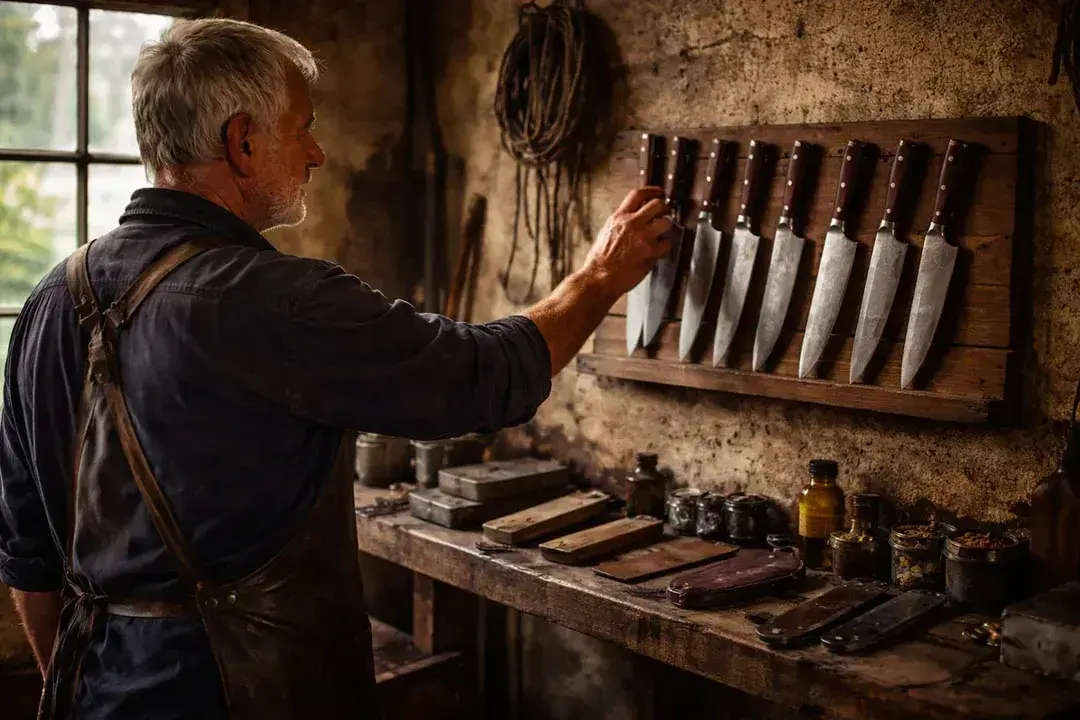
For four years, Jack Morrison forges. Every morning. Seven days a week. Chef's knives, santokus, paring knives. He stacks them on the shelf Margaret had installed for orders. Except this time, there are no orders. Just a man alone doing the only thing he knows how to do.
The blades pile up. Ten. Fifty. Two hundred. Six hundred. Each forged with the same care as if a starred chef were waiting. Each unique, because Damascus steel never repeats itself.
67 layers of steel and thousands of hammer blows
To understand why Jack Morrison's knives are worth what they're worth, you need to understand what Damascus steel actually is.
This is not ordinary steel. It is a stack of 67 different steel layers, folded and refolded at the forge. Each fold creates a unique pattern — those hypnotic ripples you see on the blade. Like a fingerprint: it is mathematically impossible for two Damascus blades to be identical.
"People think it's just about looks," says Jack. "But Damascus is mainly about performance. The layers of hard steel and flexible steel complement each other. One gives the edge, the other the flexibility. That's why my blades still cut after thirty years."
The process is long and exhausting. For a single blade, you need to:
First, heat the steel to over 900 degrees in the coal forge. Then hammer — hundreds of precise blows to fold the layers. Next, the quench: plunging the burning blade into an oil bath to lock in the molecular structure. Then polishing, grain by grain, for hours, until the Damascus patterns emerge. Finally, the handle: a block of walnut selected for its grain, cut, carved, sanded, then oiled three times.
In total, each knife takes two full days of work. And Jack engraves his initials — "JM" — on every blade. Fifty years of tradition. Not a single blade without his signature.
"When you hold a custom-forged Damascus knife, you feel it straight away. The weight, the balance, the way it drops into your palm. It's as if the blade knows what it's supposed to do."
— Jack Morrison
"Your hands won't last another winter"
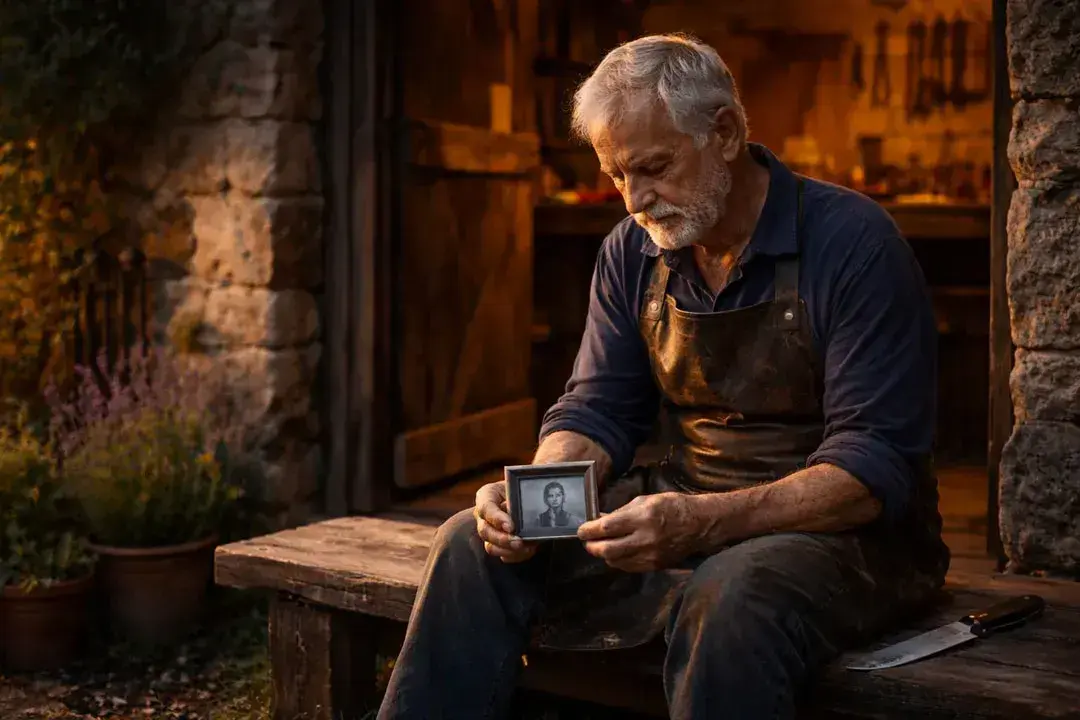
September 2025. The rheumatologist's verdict is unequivocal. Arthritis has taken hold in both hands. The finger joints are deformed. The right wrist — the hammer hand — cracks with every movement.
"Your hands won't last another winter at this pace," the doctor tells him. "Every hammer blow accelerates the damage. If you keep going, you won't even be able to hold a fork."
Jack takes it in. He knew, deep down. For two years he has been forging more and more slowly. Some mornings, his fingers refuse to bend. He needs twenty minutes under hot water before he can grip the hammer. The pain has become his work companion.
His son Eric visits one weekend. He sees the knives stacked on the shelves. He sees the unpaid bills on Margaret's desk. He sees his father's deformed hands.
"Dad, you have to stop," he says. "Mum wouldn't have wanted this."
That one hit Jack harder. Because he knows it's true.
The decision is made that evening, around the kitchen table. The forge will close. But not before every blade has found a home.
Selling direct, no middleman, at cost price
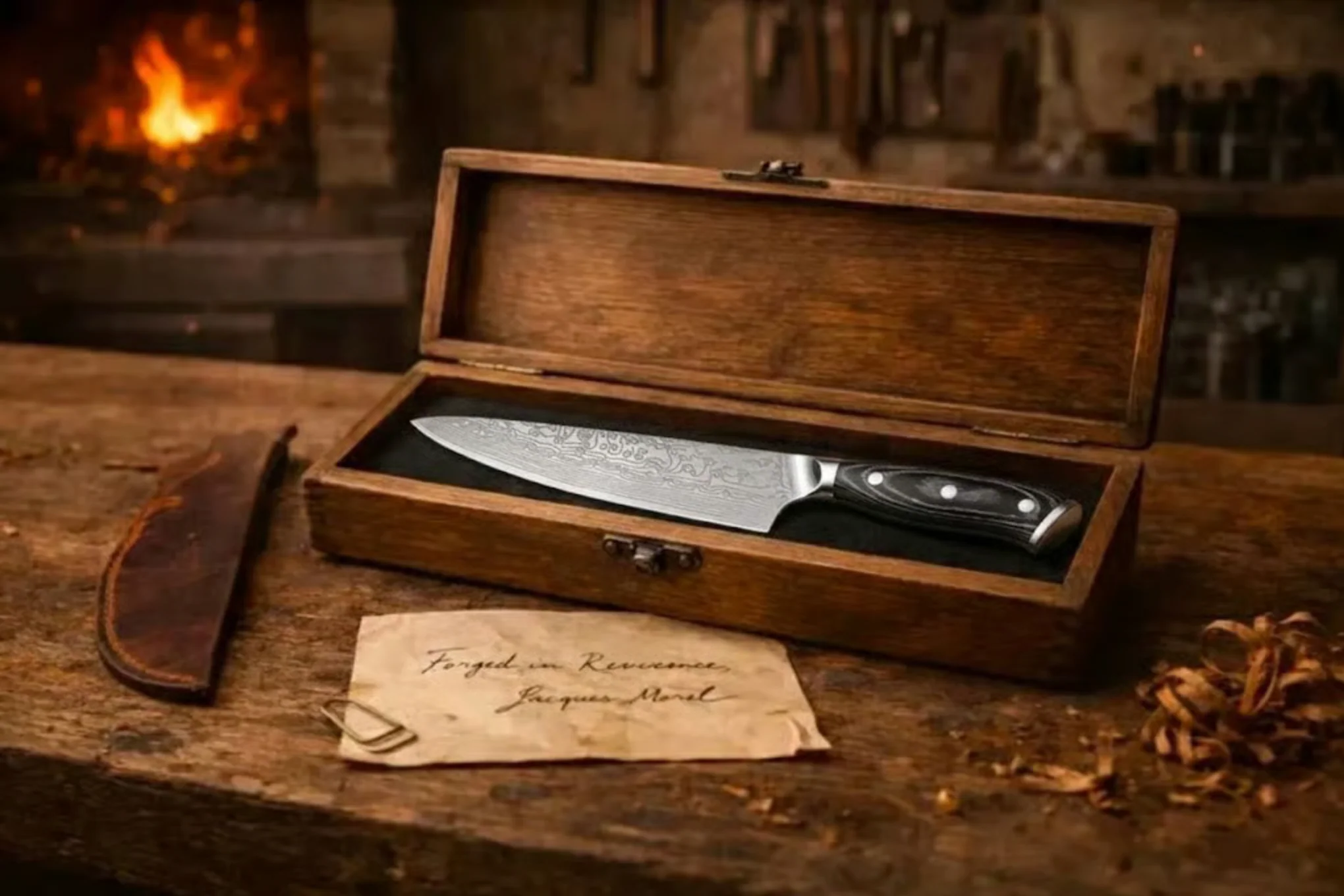
A wholesaler from Sydney offers to buy the entire stock. "I'll give you $65 each," he announces over the phone. Jack asks what he'll do with them. "Resell them for $400 to $450 in cutlery boutiques."
"I hung up," says Jack. "The idea of some bloke in a suit selling my blades for five times the price behind a glass cabinet made me sick. These knives, I forged them to be used. Not to collect dust."
It's Eric who finds the solution. Sell online, direct, no middleman. Not at $349 like Jack charged at the trade shows. Not at $450 like the wholesaler would have. At $99. The right price so every knife finds an owner who will actually use it.
When these blades are gone, that's it. No new production. No restocking. The forge goes cold and the workshop is handed back. Fifty years of craft concentrated in these last blades.
"I don't want charity," insists Jack. "I want my knives to end up in the hands of people who love to cook. People who'll understand the difference between a hand-forged blade and a knife stamped out by a machine."
CLICK HERE TO GET ONE OF GEKKO' LAST BLADESCustomers of 30 years share their stories
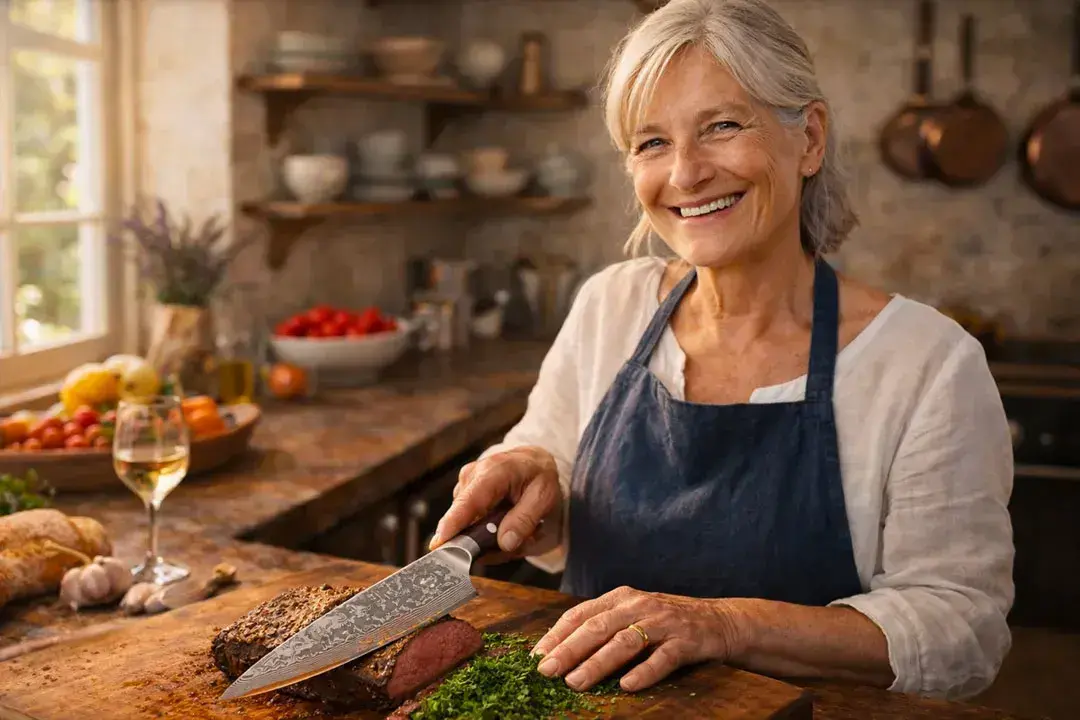
News of the closure spreads. Former customers — some loyal for decades — get in touch. Testimonials pour in.
"I bought my first knife from Jack in 1994. Thirty years later, it's still in my kitchen. It's survived three moves, two kids who used it without a care, and thousands of meals. It still cuts better than any new knife I've bought since."
— Frances L., 67, Brisbane
"My husband gave me a Jack Morrison knife for our 25th wedding anniversary. I thought it was an odd gift. Fifteen years later, it's the only thing in our kitchen I've never replaced. When I heard Jack was closing, I cried."
— Catherine D., 61, Sydney
"I've been a chef for 22 years. I've used Japanese knives at $700, German knives at $500. None of them come close to a Jack Morrison blade. When he closes, an entire chapter of French bladesmithing disappears."
— Andrew B., head chef, Melbourne
On social media, former apprentices share photos of the workshop. A local documentarian has even started shooting a short film about the forge's final days. The mayor of Healesville offered a commemorative plaque. Jack declined.
"I don't want a plaque," he says. "I want my knives to speak for me. In fifty years, if someone's cutting an onion with one of my blades and thinks: that's a proper knife — then I'll have won."
What makes these knives different from anything you've used before
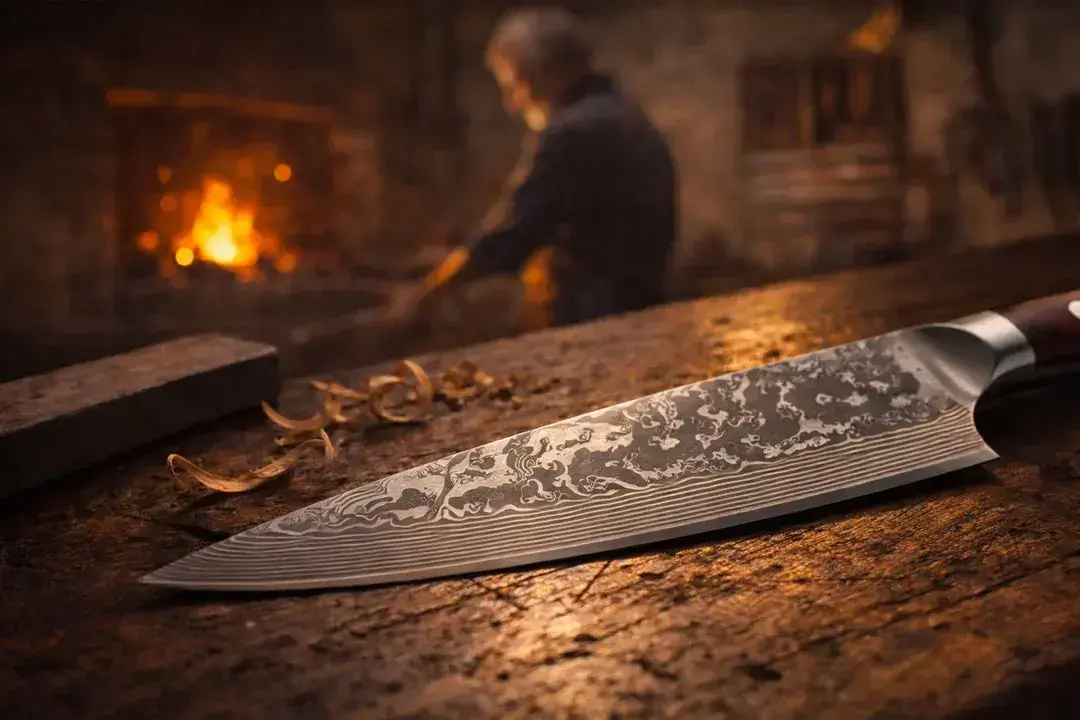
This is not an ordinary knife. Here's what sets a blade forged by Jack Morrison apart from anything you'd find in a supermarket or department store:
67-layer Damascus steel. Where a mass-produced knife uses a single layer of stainless steel, Jack's blade stacks 67 layers, folded and forged. The result: an edge that stays sharp for years without sharpening, and unique ripple patterns on every blade — the hallmark of real Damascus.
Noble wood handle. No moulded plastic. Every handle is carved from a block of walnut, sanded, then oiled three times for a perfect grip. The wood develops a patina over time and becomes more beautiful with every year of use.
Perfect balance. A custom-forged knife is balanced to the gram. The weight distributes naturally between blade and handle. The moment you pick it up, you feel the difference. The knife doesn't pull, doesn't fatigue your wrist.
A lifespan measured in decades. Jack's customers have been using their knives for 20, 30, sometimes 40 years. Damascus steel doesn't wear like ordinary steel. A quick pass on a whetstone once a year is enough to maintain a razor edge.
How to get one of the few remaining blades before it's too late
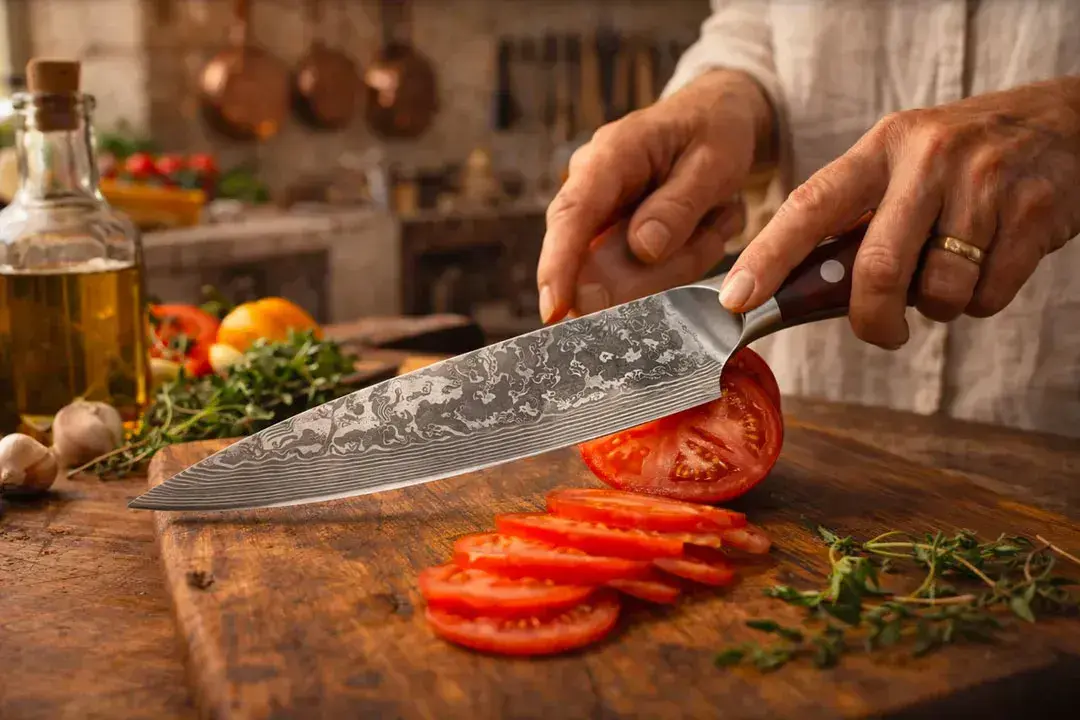
These limited knives represent everything that remains of Jack Morrison's life's work. There will be no restock. No new series. When the last knife is sold, fifty years of craft will go dark with the forge fire.
The price has been set at $99 instead of $349. This is not a marketing promotion.
It is the choice of a 76-year-old man who would rather see his blades in kitchens than in a reseller's
cabinet at $450.
Every order is checked and packed with care. Jack guarantees each knife: 30-day money-back guarantee. "If my blade doesn't convince you from the first cut, send it back," he says. "But in fifty years, no one has ever returned a knife to me."
The first orders ship within 48 hours via American Post. Reviews have been unanimous:
"Even more beautiful in person than in the photos. You can feel the work. You can feel the soul. This knife has a story and you can see it."
— Margaret R., 58, Adelaide
"My wife asked me why I was smiling while chopping carrots. I told her: because for the first time in 40 years, I've got a proper knife."
— Philip G., 63, Perth
Time is running out. Every day, dozens of blades find their owner. When it hits zero, it's truly over.
For people who love cooking. For those who recognise the value of something forged. For those who want a piece of fifty years of passion before it disappears. This chance won't come around again.
CLICK HERE TO GET ONE OF GEKKO' LAST BLADESThese images/stories/testimonies have been created using AI.
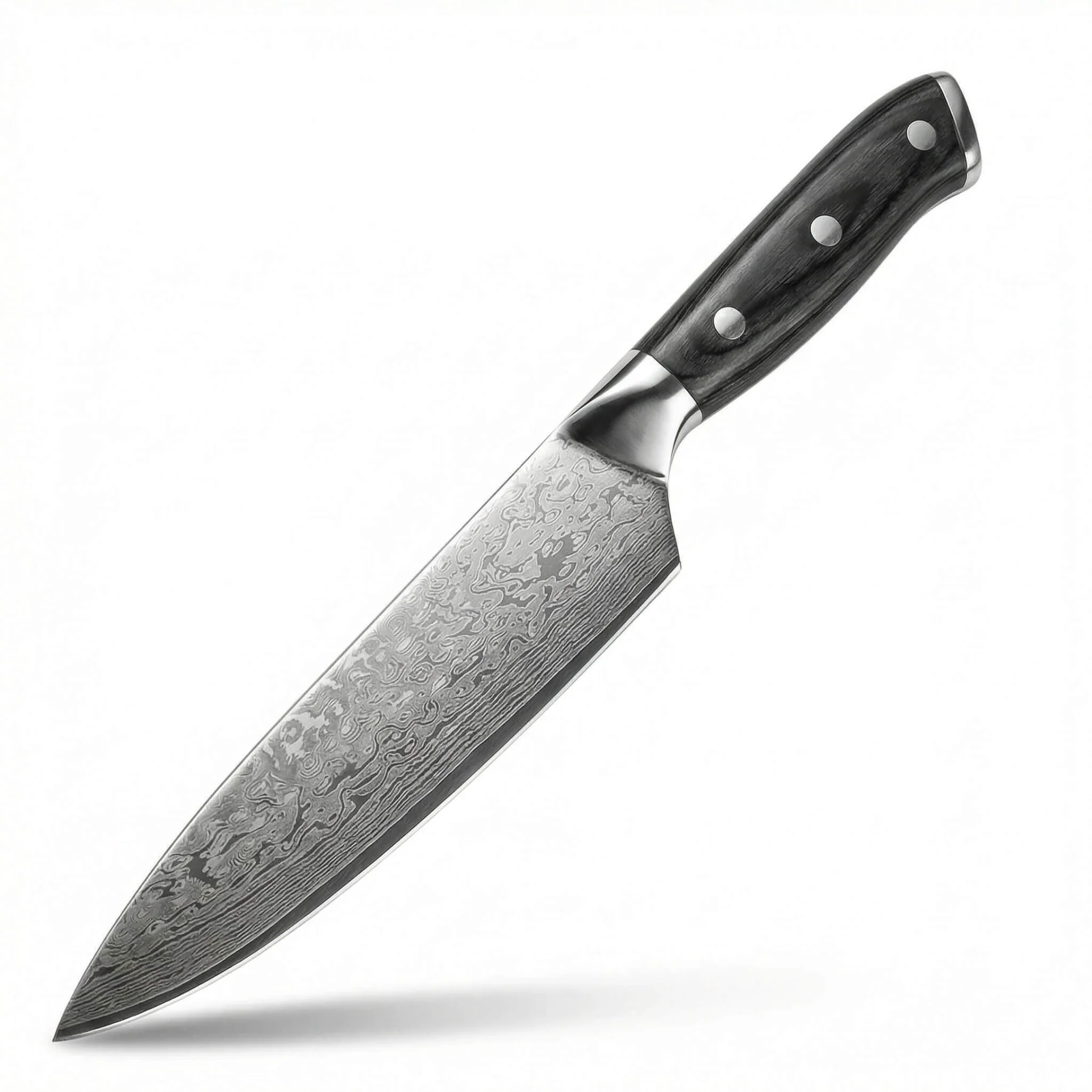
50 years of forging in every blade. A lifetime of pleasure in every cut.
👉 GET 50% OFF NOWMarketing disclaimer: This article is a sponsored publication for informational and promotional purposes. It may contain testimonials or marketing claims. Results may vary from person to person. Shared experiences reflect personal opinions and do not guarantee any particular effect.
Artificial intelligence disclaimer: The images, story, characters and testimonials presented on this page have been created or enhanced with the assistance of artificial intelligence. Any resemblance to real persons, living or deceased, is purely coincidental. The promotional prices displayed are reduced prices offered as part of an online commercial operation, with no guaranteed duration and subject to change at any time.
© 2026 All rights reserved.